[ Home ] [ Messages and Signs ] [ In Defense of the Truth ] [ Saints ] [ Pilgrimages ] [ Testimonies ] [ Ordering ]
|
A SPECIAL PHOTOGRAPH OF A TESTIMONY AND REFLECTION
Picture
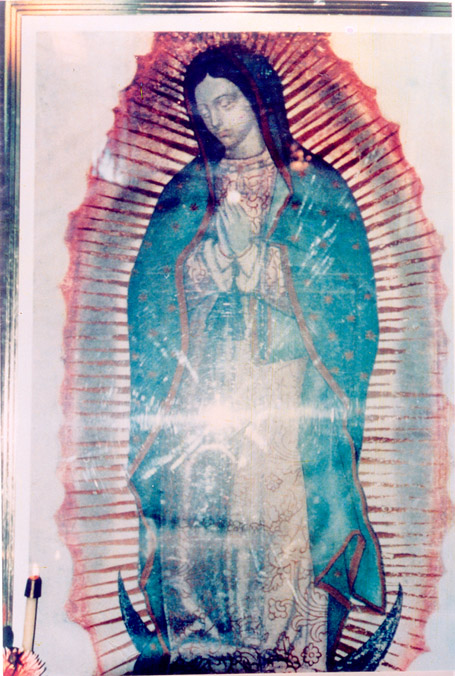
#1 DECLARATION: This photograph of the Missionary Image of Our Lady of Guadalupe in Picture #1 was taken by me at the National Sanctuary of Our Sorrowful Mother in Portland, Oregon on August 15, 1991, Solemnity of Our Lady's Assumption, with my sole intention to have a replica of the Missionary Image of Our Lady of Guadalupe in our living room. After this photograph was developed and printed, I and my family found some unexpected new images in the photograph, which may have some significance to the faithful in the Church. The reports of the facts and our experience are in this testimony. The official discernment of this photograph and this testimony belongs to the proper Church authorities. I swear that the contents of this testimony are true and accurate to the best of my knowledge and conscience. Additional information will be provided when requested by the Church authorities to the extent of our knowledge. ― Benedict Lee, May 15, 2014
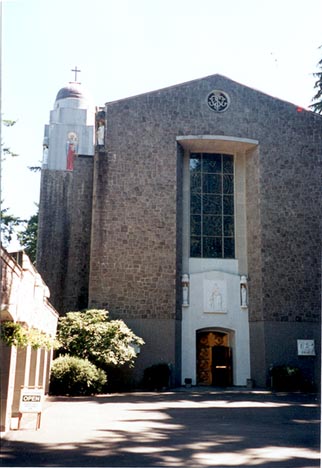
The location of the National
Sanctuary of Our Sorrowful Mother in the northeast part of Portland and only 4 miles from the Portland International Airport
Left, Picture #2: The chapel at the
National Sanctuary of Our Sorrowful Mother in Portland, Oregon (also
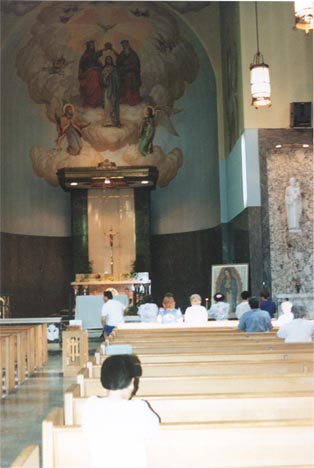
called "The Grotto"). In Picture #3, on the front wall above the altar in the chapel, there is a large and beautiful drawing of the Blessed Mother receiving the royal crown from the Holy Trinity, which confirms that Our Lady is truly the Queen of the World and also that the Holy Trinity bestows on her the power necessary for defeating Satan and repelling him along with all his subordinates from this world and thus winning her Triumph (cf.: Gen. 3:15 & The Apocalypse 12). Following the cleansing of the world and Our Lady's Triumph, the Holy Spirit will open a new world of true faith and peace reigned by Our Lord in the Holy Eucharist. This drawing in the chapel is an excellent depiction of what is most needed for us who live in this current world, which is mired in errors, pride, vanity, moral laxity and disorder, and loss of the faith. What we need most is God's help through Our Lady so that we may repent our sins and rebuild healthy families and societies according to God's teachings and moral laws. Our Lady told us through Sr. Natalia of Hungary (1901-1992) about her essential role for our salvation: "My power over the world as a Queen is a blessing and grace to all souls, to all nations, and to the whole world. If I do not talk to you, you cannot speak to my Son. If power over the world were not given to me, the world would have sunk into the hell of annihilation long ago. My power is the power of Mother over her little ones, who without that protection would have been destroyed." The following is an excerpt from the book: "The Victorious Queen of the World" written by Mr. Stephen A. Foglein (1936-2002):
It seems most appropriate that the special photograph of Our Lady of Guadalupe was taken under the solemn image of the Holy Trinity crowning Our Lady as the Queen of the World and entrusting the task of defeating Satan to her for the purpose of rescuing her children from Satan's bondage.
A sign in the sky before the
arrival
Our simultaneous connections with Guadalupe and Naju On August 19, 1991, four days after the photograph was taken at the Grotto (but it was not developed until after we returned from the trip to Europe), Chris and I went to Lourdes, France. It was our first ever trip to Europe. My 85 year-old mother and my wife stayed home. The 3-day stay in Lourdes was an awesome and spiritually productive experience. We realized later that the day we arrived in Lourdes by train was the early morning of August 22, 1991, the Feast of Our Lady's Queenship. On the same day, the three-day coup by the radical Communists in the Soviet Union failed and Gorbachev was released. After Lourdes, we went to Frankfurt, Germany for my business reasons. We came home on August 30.One and a half months after our return from Europe, I had to go to Seoul, Korea for a business meeting. On October 19, 1991, Saturday, I took an express bus from Seoul to Naju, which took about 5 hours. I had wanted to visit Naju for several years, as I had learned about it through Pittsburg Center of Peace and the video: Marian Apparitions of the 20th Century. I was excited about this first visit to Naju in Korea where I had been born and grown up. In the chapel in Naju, I saw some tears in the Blessed Mother's left eye. Her statue was smaller (about 20 in. tall) than I had thought but very holy and beautiful. After attending the Saturday vigil Mass at the nearby Naju Parish Church, I came back to the chapel. When I entered the front yard of the chapel, I smelled a strong, pleasant fragrance. At first I did not know where it was coming from, but soon remembered the fragrance of roses mentioned in the Lives of the Saints. My joy was great, feeling that I was smelling the fragrance from Heaven. As I entered the chapel, the fragrance became stronger and lasted all night until morning. I learned that it was the 5th anniversary of Our Lady's first shedding tears of blood in Naju and there was an all-night prayer meeting in the chapel. So, I did not have to look for a place for sleep. The chapel was packed with people and prayer meeting began in the atmosphere of genuine faith, joy, and love. The participants all seemed to have come to the prayer meeting many times and seemed to take the powerful fragrance for granted. Julia's testimony also was filled with good spirits and encouragement. In the early morning, I was invited to Julia's house next to the chapel for breakfast. I told Julia that I would translate the Blessed Mother's messages into English and she was happy to hear that. After saying Good Bye, I took the bus to Seoul. After the arrival in Seoul, I could still smell the fragrance from my cloths. A few days later, I returned to the States and shared the amazing information about Naju with others who were so eager to know more about Naju. Soon I began to translate the Naju messages and, in October 1992, Chris and I went to Korea carrying two heavy boxes of the new English message book, one to Naju and another to Fr. Raymond Spies, Julia's spiritual director. At that time I was not even imagining the possibility of working full time to spread the Catholic Faith and the information about Naju, but gradually I felt the calling and decided to follow it. We eventually closed our small family-owned export company and started a non-profit organization called Mary's Touch by Mail and registered it with the State of Oregon and the IRS. We began publishing books, pamphlets, and DVD's and also opened a website: www.marys-touch.com. I was happy, because, since my conversion to the Catholic Faith from the Protestant faith during my high school years in Korea, I liked to study and spread the Catholic Faith. Our English message book was translated into dozens of other languages by the volunteers in different countries. Our spiritual director is a very holy priest in Los Angeles. Also, five Bishops (3 in the Vatican, 1 in Canada, and 1 in Korea) had been spiritually supporting us but three of them passed away and two retired. Spiritually, they continue to be with us. Mary's Touch by Mail is small, but we make efforts to reach more people in the world. We believe that our simultaneous connections with Guadalupe and Naju were significant. The Blessed Mother came to Guadalupe in 1531, when the period of one thousand years of the strong Catholic Faith in the Western World ended; many Protestant denominations were sprouting; and the Americas were being explored. The 500 years since 1500's have been a period of a critical war between Our Lady and Satan. The war is at its climax now and is rushing to its conclusion. All of us are called by Our Lady to assist her with our maximum efforts.
An unexpected appearance of the
image After our return from Europe on August 30, 1991, we had several rolls of film developed including the photograph taken in Portland and others taken in Europe. Before photographing the Missionary Image of Our Lady of Guadalupe on August 15, 1991, I had one serious anxiety that, because the Missionary Image of Our Lady of Guadalupe was covered with glass, it was certain that a reflection of the flashlight would appear in the photograph. I could not think of any way to avoid it. I felt helpless but took the photograph anyway. When we had the films developed later at Costco Warehouse, we indeed saw the large reflection of the camera flashlight in the middle of the photograph. I felt frustrated thinking that it was a failure. At the same time, we were puzzled by a small white and round image at the tip of the Blessed Mother's fingers looking like the Eucharist. When I looked at the image closely, it was not a perfect circle as the Eucharist should be. But as soon as I looked at it at some distance, the image was perfectly round. The size of the image was about the same as the hosts used for lay people. The hosts used by the priests celebrating the Mass are larger. My family was amazed, but could not say that it was truly an image of the Eucharist, as the evidence was insufficient. Nevertheless, it was still amazing that the image appeared exactly at the tip of Our Lady's hands, a very appropriate place for the Holy Eucharist to be. In the original Image of 1531, the Blessed Mother is folding her hands to pray for the past 500 years for all of her beloved children worldwide. Everything in the world and in our daily life can be called "a miracle", as it was made and is being supported by God. We, humans, cannot make anything out of nothing. We cannot even make a little bird or ant that is alive. But sometimes God sends us the signs that can be noticed by our senses but exceed the natural laws for His special purpose and these can be called the genuine, supernatural miracles. If the new image of the Eucharist in the photograph satisfied the qualifications of true miracles, we should handle and treat it with utmost respect and care. The fact that it came through a lowly and unworthy person is irrelevant. For several months, we were wondering and not ready to admit that it was a miracle.
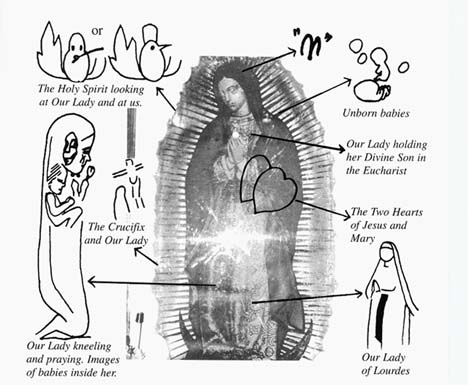
More new images found in the following months I showed this photograph to several people at the Marian center in Portland and they were amazed. Then, over the next several months, some more images were found in the photograph (See Picture #4 below), sometimes by me and sometimes by others. These additional images may appear not clear at first glance, but, after one recognizes them, the images become clear and obvious. Besides, these multiple images all seemed to contain some important theological meanings not in a random and disorderly manner but in harmony with the authentic Catholic Faith and converging to one same theme which is our salvation. We also wondered how all these new images appeared simultaneously in one photograph. Besides, the original Image has already been approved by the Church, brought about millions of conversions in Latin America, and have been loved by billions of people in the world for the past 500 years. Who can dare even imagine any new images added to this sacred and solemn Image unless it is by God Himself? A priest, who is a highly respected expert on the Image of Our Lady of Guadalupe, sent an e-mail to a friend of mine saying that he believed this photograph to be miraculous, but he will keep it private until the Bishop recognizes it. The priest also said that the new images in the photograph were not additions to the original Image but a revelation of the facts that had been contained but hidden in the original Image until now, as buds blossom into flowers at the right time. We fully agree with him. Through this blossoming, Our Lady of Guadalupe can work more actively in the whole world to convert sinners, end abortions and other sins, and save more souls. The new images found in the photograph are listed below:
This image can be seen as the Holy Spirit looking at Our Lady or looking at us, the people in the world, with an olive branch in his bill meaning "peace". This image of the Holy Spirit was formed by the high window in the chapel and the tree leaves outside the window. For several weeks, I only saw it as a reflection of the window and trees, but a visionary lady in Scottsdale, Arizona telephoned another lady at the Marian Center in Portland and told her that it was an image of the Holy Spirit.
Picture
#4
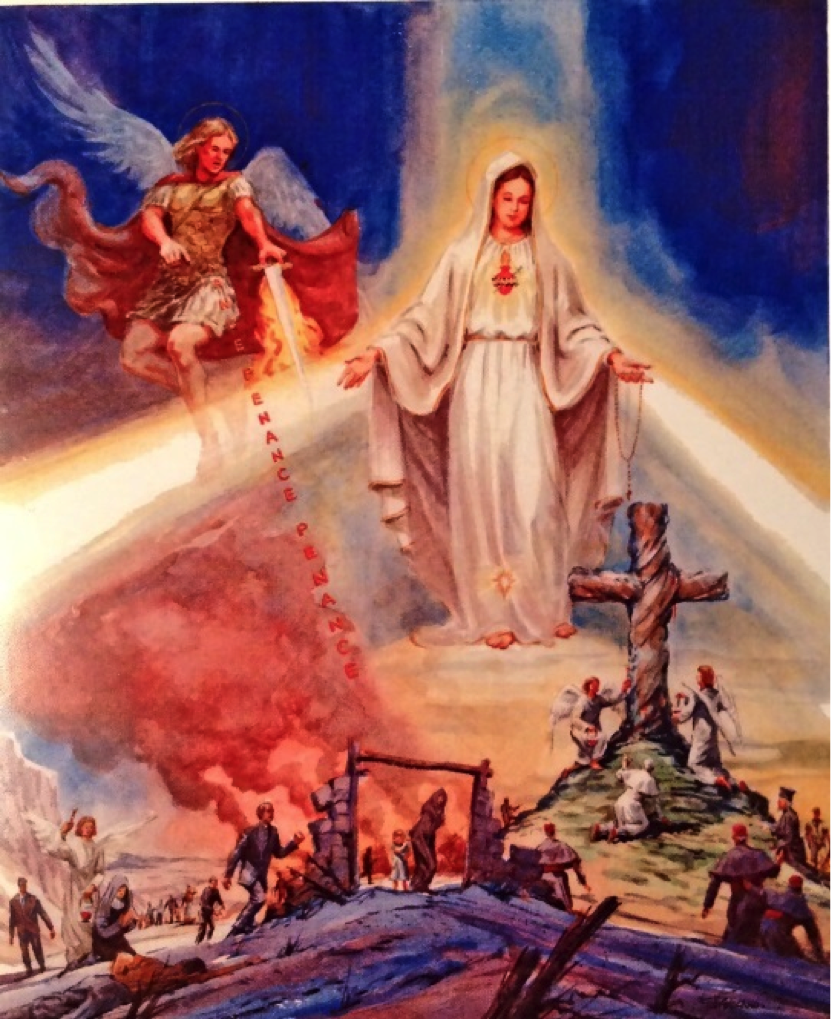
The Third Secret of Fatima according to Sr. Lucia's testimony
Concluding Words The area below the bright light in the photograph of August 15, 1991 contains many images about sufferings, sorrows, and devil's attacks, which exactly describe our current world. The area above the bright light in the photograph describes the world after the cleansing, with the images of the Holy Eucharist, the Holy Spirit, Our Lady's Immaculate Heart, and Our Lady's black hair without the veil on her head for her coronation by the Holy Trinity. There are even little unborn babies on Our Lady's left shoulder who avoided abortion and survived. Thus, this photograph taken on August 15, 1991 shows us the details of the current world so miserable and dangerous and the new world to be reigned by Our Lord of the Holy Eucharist and filled with love, truth, order, and peace. One may question why there are so many little images and signs in the photograph of Our Lady of Guadalupe, but that was also the method of teaching that Our Lady used in the original Image of 1531. Finally, we may learn some lessons from the signs in the Image of Our Lady: "Avoid sins!", "Do constant penance for our sins and others'!", "Have total trust in the Lord and the Blessed Mother, as we alone cannot defeat Satan or sanctify our souls!", "Adhere firmly to the authentic Faith and moral discipline!", "Restore love, forgiveness, and prayers in our families, society, and world!", and "Restore the devotions to the Holy Eucharist and Our Lady as these are the two pillars of the Church as seen in St. Don Bosco's prophetic dream."
"Hail, O Virgin of Guadalupe! As long as you are
recognized ― Pope Pius XII in October 1945Please visit our website for more information: www.marys-touch.com. |
[ Home ] [ Messages
and Signs ] [ In Defense of the Truth ] [ Saints
] [ Pilgrimages ] [ Testimonies
] [ Ordering ]